
Fiber Optic vs. Copper HDMI Cables: A Concise Comparison

Fiber Optic vs. Copper HDMI Cables

Table of Contents

HDMI cables are essential for high-quality audiovisual transmission, but choosing betweenย fiber-opticย andย copper HDMI cablesย depends on your specific needs. Below is a detailed comparison to guide your decision.


1. Transmission Technology & Structure
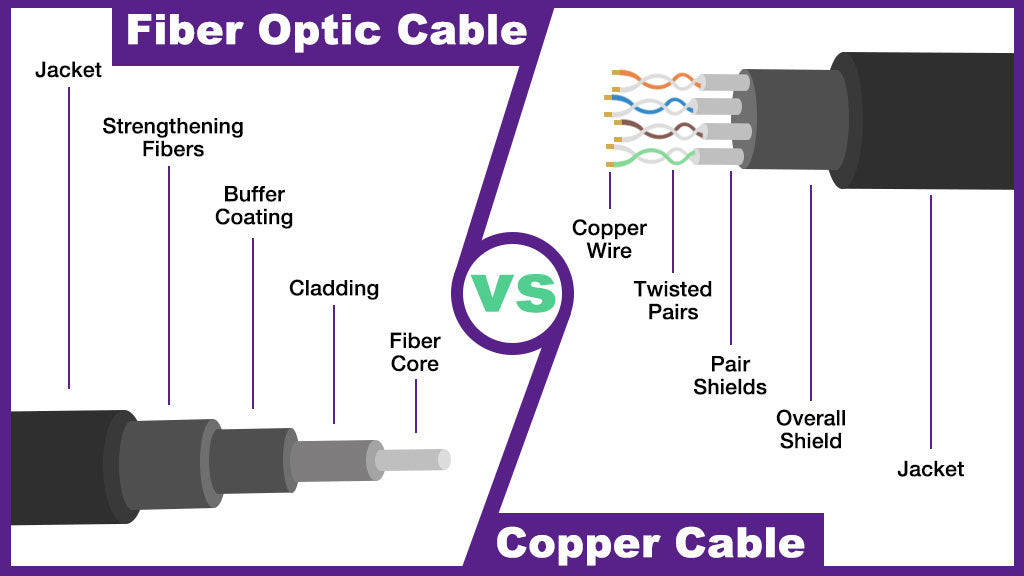
  • Copper HDMI Cables:
    Constructed with copper wires, these cables transmit electrical signals. They are thicker, less flexible, and prone to electromagnetic interference (EMI) or radio-frequency interference (RFI), especially over long distances.
  • Fiber Optic HDMI Cables:
    Utilize fiber-optic cores and photoelectric conversion chips. Light signals (via lasers) replace electrical currents, enabling faster, interference-free transmission. These cables are thinner, lighter, and more flexible.


2. Signal Quality & Distance

Feature Copper HDMI Fiber Optic HDMI
Max Distance 15โ€“20 meters (4K/8K) Up to 100 meters (4K/8K)
Signal Loss Significant over 15m Minimal even at 100m
EMI/RFI Resistance Vulnerable Immune

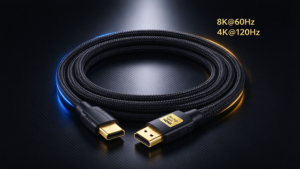
Regular HDMI cables struggle with signal degradation beyond 15 meters, often requiring signal boosters. Directional HDMI maintains 8K@60Hz/48Gbps performance over extended distances without additional hardware.


3. Directionality & Installation

  • Copper HDMI:
    Bidirectionalโ€”no fixed input/output ends. Plug-and-play flexibility simplifies installation.
  • Fiber Optic HDMI:
    Unidirectionalโ€”ends are labeled โ€œSourceโ€ (input) and โ€œDisplayโ€ (output). Incorrect installation disrupts signal flow. However, some models feature detachable connectors (e.g.,ย Micro HDMI) for compatibility with smartphones or tight spaces.


4. Durability & Cost

  • Durability:
    Copper cables are sturdier but bulkier. Fiber-optic cores are fragile; excessive bending or force may damage internal fibers.
  • Cost:
    Regular HDMI is cost-effective (e.g., $10โ€“$30 for 3m). Directional HDMI costs 3โ€“5ร— more (e.g., $100โ€“$300 for 3โ€“10m), though prices are gradually decreasing.


5. Ideal Use Cases

  • Copper HDMI:
    Short-distance setups (โ‰ค10m), budget-conscious projects, or environments without EMI risks (e.g., home gaming consoles).
  • Fiber Optic HDMI:
    Long-distance installations (e.g., home theaters, conference rooms), EMI-heavy industrial settings, or setups requiring ultra-high resolutions (8K HDR).


Conclusion

Directional HDMI excels in performance and reliability for professional or long-range applications, while regular HDMI remains practical for everyday use. Always verify cable specifications (e.g., HDMI 2.1 certification) and prioritize shielded designs for critical setups.


FAQ
Q1: Can directional HDMI cables be used interchangeably with regular HDMI cables?
No. Directional HDMI cables (typically fiber optic) have a specific signal path from โ€œsourceโ€ to โ€œdisplayโ€ due to their internal design. Reversing the direction may disrupt signal transmission. Regular HDMI cables (copper-based) are bidirectional and work in any orientation.


Q2: When should I choose a directional HDMI cable over a regular one?
Opt for directional cables in scenarios requiring:
  • Long-distance signal transmission (15+ meters) without signal degradation.
  • High-bandwidth applications (e.g., 8K/60Hz, HDR, or Dolby Atmos).
  • Electromagnetic interference-prone environments (e.g., near power cables).


Q3: Do directional HDMI cables require special equipment or setup?
No external adapters are needed, but ensure the cable is correctly oriented:
  • Labeled โ€œsourceโ€ end connects to devices like gaming consoles or Blu-ray players.
  • Labeled โ€œdisplayโ€ end connects to TVs, projectors, or monitors.


Q4: Are directional HDMI cables more expensive than regular ones?
Yes. Fiber optic directional cables cost 2โ€“3 times more than copper-based regular HDMI cables due to advanced materials and manufacturing. However, they offer superior performance for professional or high-end home theater setups.
Submit Your Sourcing Request
RELATED POSTS

REQUEST A FREE QUOTE

contact us to get latest product catalog