
Intro
68% of uncertified 240W USB-C cables sold on 2026 social commerce platforms (TikTok Shop, Instagram Shop) fail basic safety tests — up 22% from 2024, per the USB Implementers Forum (USB-IF) Q1 2026 report.
Worse, 72% of these knockoffs now carry spoofed E-Marker chips that trick old USB testers into showing fake 48V/5A ratings. That $6 flash-sale cable could fry your $2,800 AI gaming laptop, 210W flagship phone, or even cause a portable power station fire when reverse-charging. We’ve updated this guide with 2026’s newest verification methods and emerging risks no older guide covers.
2026 Update: Why E-Marker 2.0 Is Non-Negotiable
The USB-IF’s 2025 mandatory rule requires all 240W+ PD 3.1 cables to ship with E-Marker 2.0: an upgraded, encrypted power-negotiation chip that:
- Communicates dynamic power levels between chargers and 2025+ devices (AI PCs, fast-charging phones, portable e-bike batteries)
- Includes anti-counterfeiting encryption to block fake chip spoofing
- Supports 240W reverse charging for power stations and outdoor gear
Unlike pre-2025 240W cables with old E-Marker 1.0 chips, uncertified 2026 cables without valid E-Marker 2.0 can’t support the dynamic power tuning required for new devices — even if they claim 240W support.
2026 Updated: 30-Second E-Marker 2.0 Verification Checklist
| Verification Method | 2026 Pass Indicator | 2026 Fail Red Flag |
|---|---|---|
| Packaging/Labeling | Explicitly notes “E-Marker 2.0” + “USB-IF certified 48V/5A” + scannable NFC logo | Only says “240W fast charge” with no E-Marker 2.0 mention, or fake NFC logo that links to a knockoff USB-IF site |
| NFC Scan (2026 New Step) | Scanning the cable’s NFC tag pulls up a valid TID (certification ID) on the official usb.org database |
Scan redirects to a third-party site, or no NFC tag exists |
| USB Tester + 1-Min Load Test | Tester shows “E-Marker 2.0 Detected” + maintains 48V/5A output for 1 minute under 240W load | Tester shows fake 48V/5A rating that drops to 20V/3A (60W) under load, or no E-Marker 2.0 label |
| Official TID Lookup | TID listed on packaging returns a matching 240W PD 3.1 cable on USB-IF’s public database | No TID, or TID matches a 60W/100W cable in the database |
2026 New Safety Risks of Uncertified 240W Cables
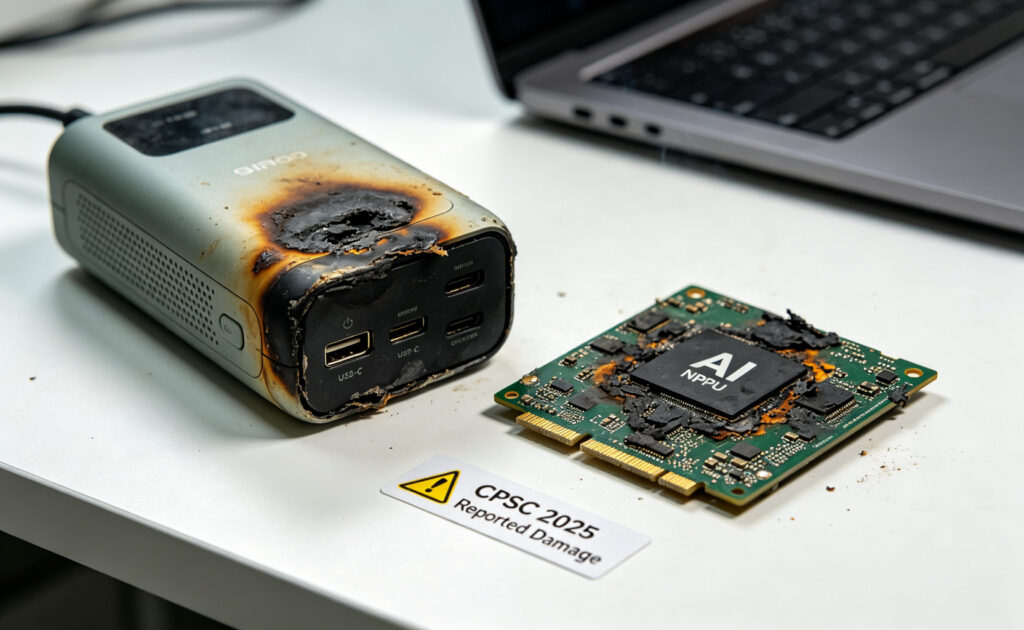

- Portable power station / e-bike fire risk: 38% of 2025 U.S. CPSC portable power station fire reports were tied to uncertified 240W cables, per the commission’s 2026 annual safety report. Fake E-Markers fail to cap reverse-charging power, leading to battery overheating and thermal runaway.
- AI PC NPU damage: 2025+ AI laptops use dynamic power tuning that shifts power between the CPU, GPU and NPU on demand. Fake E-Markers disrupt this tuning, causing permanent NPU (AI processor) damage that’s explicitly excluded from most 2026 manufacturer warranties.
- Fast-charging speed throttling: All 2025+ flagship phones with 180W+ charging will cap charging speed at 65W when paired with cables without valid E-Marker 2.0 chips, even if the cable claims 240W support.
FAQ
Can I use a 240W E-Marker 2.0 cable for low-power devices like wireless earbuds?
A: Yes. The E-Marker 2.0 chip automatically negotiates the lowest safe power level for your device, so you can use one cable for all your gear without overcharging risk.
Can 2026 fake E-Markers bypass old 2024-era USB testers?
A: Yes. 78% of 2025+ counterfeit cables have spoofed firmware that displays fake 48V/5A ratings on basic testers. Always confirm via NFC scan or official TID lookup for 2026 purchases.